
The excellent Robin Wigglesworth of the Financial Times has already covered this subject in depth, so I am not trying to reproduce that work. But I thought the chart below from the Fed was a cracking insight into how hedge funds are using treasuries and deserves a bit more attention.
The US has issued an enormous amount of debt, and hedge funds’ presence in the Treasury market has grown faster still. But the way some outlets cover their activity, you would think Uncle Sam has been spending on credit cards issued by Messrs. Griffin and Englander. Of course, hedge funds aren’t holders of govies in the same way pension funds and life insurance companies are.
Indeed, the Fed estimates that while large hedge funds had $4.0tn of gross Treasury exposure in September 2025, $2.4tn of this was long and $1.6tn was short. The interesting part is what sits inside the $2.4tn long book. The vast majority corresponds to the cash leg of basis, swap-spread, maturity-matched and yield-curve trades.
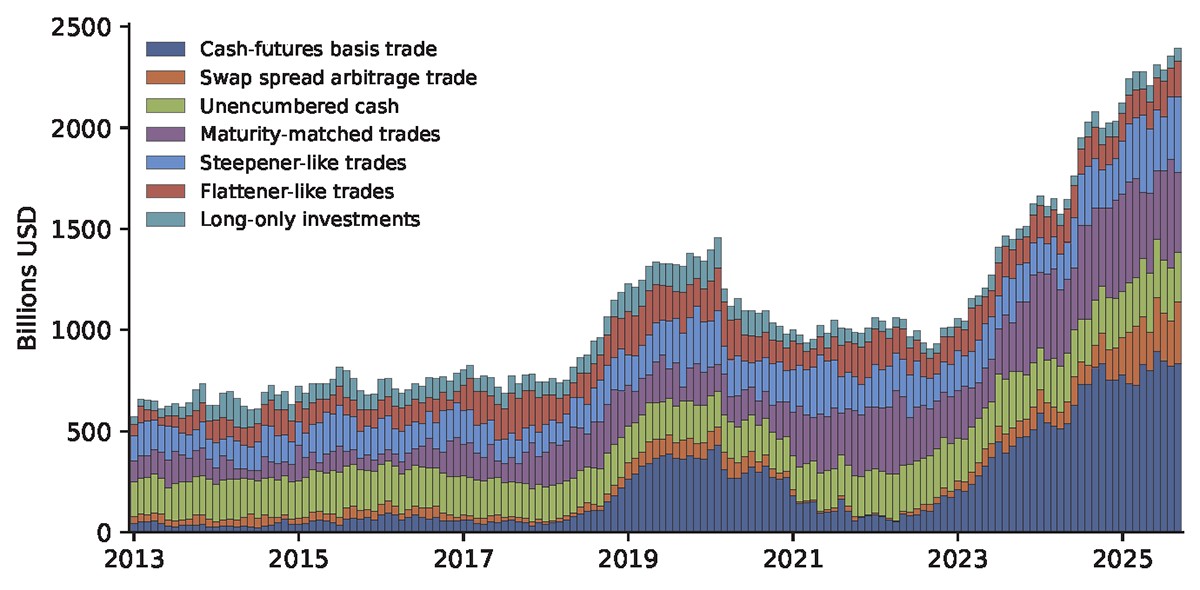
To expand on the above categories, we have:
- Cash-futures basis trade (35% of long exposure) - A hedge fund buys a cash Treasury and shorts the corresponding future, which typically trades more richly due to its capital efficiency, making a profit on the spread. The cash Treasury is purchased on repo so they can lever the whole trade up. Whilst the Hedge Fund legally owns the physical bond, they have little outright duration exposure.
- Swap spread arbitrage trade (13%) – as above, but with swaps instead of futures.
- Maturity-matched trades (16%) – typically the hedge fund is long ‘off-the-run’ bonds due to their reduced liquidity and cheapness and short the ‘on-the-run’ issue which tends to trade more richly. Can also include plays on TIPS.
- Steepener/Flattener plays (23%) – the hedge fund is long one part of the Treasury curve, but short another part.
- Unencumbered cash (10%) – not a trade per se, more to do with collateral and liquidity management.
So, only $67bn - roughly 3% - falls into the Fed’s residual ‘long-only’ category. That does not mean the remaining 97% is entirely duration-neutral, but it does make the headline $2.4tn a very poor measure of structural Treasury demand. So, overall, hedge funds are better understood as leveraged warehouses and intermediaries that enhance liquidity and efficient pricing than as a pool of savers propping up the US government.
Hedge funds are still important. And their growing footprint is also concentrated with the largest 50 funds accounting for roughly 90% of the exposure. That scale and concentration matters because, if funding tightens or margins rise, positions can unwind quickly and transmit stress across cash, futures and repo markets. The basis trade is the most obvious fault line: its sheer size and leverage mean that a disorderly unwind could become a problem for the wider market, as March 2020 demonstrated.
The reassurance, such as it is, is that this is not a hidden risk. The Fed is clearly monitoring it and appears to understand where the vulnerabilities lie. But monitored does not mean protected. Kevin Warsh has long emphasised market discipline and limiting expectations of government intervention. A Warsh Fed might still act to preserve Treasury-market functioning, but that is not the same as shielding hedge funds from losses. Investors should not assume that every disorderly unwind will come with a rescue.